Mimar Sinan Fine Arts University Institutional Repository
DSpace@MSGSÜ digitally stores academic resources such as books, articles, dissertations, bulletins, reports, research data published directly or indirectly by Mimar Sinan Fine Arts University in international standarts, helps track the academic performance of the university, provides long term preservation for resources and makes publications available to Open Access in accordance with their copyright to increase the effect of publications.Search MSGSÜ
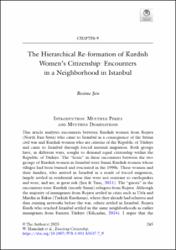
The Hierarchical Re-formation of Kurdish Women’s Citizenship: Encounters in a Neighborhood in Istanbul
| dc.contributor.author | Şen, Besime | |
| dc.date.accessioned | 2025-12-04T09:16:08Z | |
| dc.date.available | 2025-12-04T09:16:08Z | |
| dc.date.issued | 2025 | en_US |
| dc.identifier.citation | Şen, B. (2025). The Hierarchical Re-formation of Kurdish Women’s Citizenship: Encounters in a Neighborhood in Istanbul. In: Enacting Citizenship. Palgrave Macmillan, Cham. https://doi.org/10.1007/978-3-031-83537-7_9 | en_US |
| dc.identifier.isbn | 978-3-031-83536-0 | |
| dc.identifier.isbn | 978-3-031-83537-7 | |
| dc.identifier.uri | https://doi.org/10.1007/978-3-031-83537-7_9 | |
| dc.identifier.uri | https://hdl.handle.net/20.500.14124/10200 | |
| dc.description.abstract | This chapter investigates the encounters between Kurdish women from Rojava (Syria) and Kurdish women from Türkiye in a poor and politicized neighborhood in Istanbul. Both groups have settled in the neighborhood after forced migration, the first during the Syrian war, and the latter during the destruction of villages in Kurdish regions in Türkiye in the 1990s. Within this process of Kurdish women establishing their lives after forced migration, socio-spatial factors such as home, neighborhood, and city turned out to play an important role. The women met individually and supported each other, predominantly in the home. Their precarious positions made security a central issue during settlement and at the same time created hierarchies in which Türkiye’s Kurdish women, who had established a more secure position, disengaged themselves from Rojava Kurdish women in public space. The Rojava Kurdish women also found support through the Kitchen Project, an NGO project in the neighborhood, which entailed other hierarchies between NGO workers and refugees. The findings of this research show that multiple hierarchical positions, including class, gender, ethnicity, and religious identities, are formed at the scale of the neighborhood. Conditions of war and displacement are current and historical factors that shape the citizenship practices of Kurdish women. © 2025 The Editor(s) (if applicable) and The Author(s). | en_US |
| dc.language.iso | eng | en_US |
| dc.publisher | Springer | en_US |
| dc.relation.ispartof | Enacting Citizenship: Kurdish Women’s Resilience, Activism and Creativity | en_US |
| dc.rights | info:eu-repo/semantics/openAccess | en_US |
| dc.subject | Empowerment | en_US |
| dc.subject | Forced migration | en_US |
| dc.subject | Home | en_US |
| dc.subject | NGO | en_US |
| dc.subject | Security | en_US |
| dc.subject | Socio-spatial factors | en_US |
| dc.title | The Hierarchical Re-formation of Kurdish Women’s Citizenship: Encounters in a Neighborhood in Istanbul | en_US |
| dc.type | bookPart | en_US |
| dc.authorid | 0000-0001-5878-9233 | en_US |
| dc.department | Fakülteler, Mimarlık Fakültesi, Şehir ve Bölge Planlama Bölümü | en_US |
| dc.institutionauthor | Besime, Şen | |
| dc.identifier.doi | 10.1007/978-3-031-83537-7_9 | en_US |
| dc.identifier.startpage | 245 | en_US |
| dc.identifier.endpage | 275 | en_US |
| dc.relation.publicationcategory | Kitap Bölümü - Uluslararası | en_US |
| dc.authorwosid | MLF-6034-2025 | en_US |
| dc.authorscopusid | 60202906100 | en_US |
| dc.identifier.scopus | 2-s2.0-105022335627 | en_US |
Files in this item
This item appears in the following Collection(s)
-
Տcopus [1664]
Scopus | Abstract and citation database